Leif Erikson
-
Surprise! Entry #21 in project #EuropeanBios is just minutes after #20 because it's basically a two-parter. It's Leif Eriksson. He's the son of Erik the Red, who we just finished covering. Like his dad, Leif was an adventuresome bad-ass of a Viking.
-
Sometime around 986 a dude called Bjarni Herjólfsson had drifted off-course while sailing around and ended up sighting North America. He went back to Greenland and told everybody about it, and Leif Eriksson decided that going to find this mysterious other land sounded good.
-
His reason for doing so was economic and environmental: Greenland doesn't grow a lot of trees, and the Vikings had already cut them all down. They needed timber for their boats. Getting it from Europe was expensive, and according to Herjólfsson the land he saw was heavily wooded.
-
So Leif and pals headed off to North America, a mere 200 mile sea journey, nothing to people who regularly traveled by sea between Greenland, Iceland and Norway. They found what was probably Baffin Island, then probably Labrador, then a place called "Vinland".
-
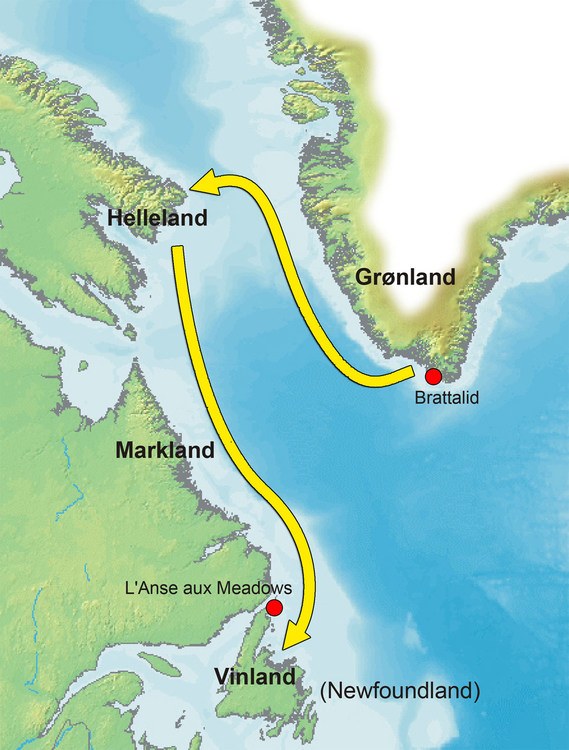
Map showing Leif Erikson's voyage route from Brattalid in Greenland to Helluland (Baffin Island) then Markland (Labrador) and Vinland (Newfoundland) Map of the sea route to Vinland by Finn Bjørklid, via Wikimedia Commons (CC BY-SA 2.5) -
Vinland's location is hotly debated by historians, but the ruins of a Viking settlement were found in 1963 at L'Anse aux Meadows in Newfoundland, so this is the most likely site by some considerable margin. But historians like debating; some put Vinland as far south as New York.
-
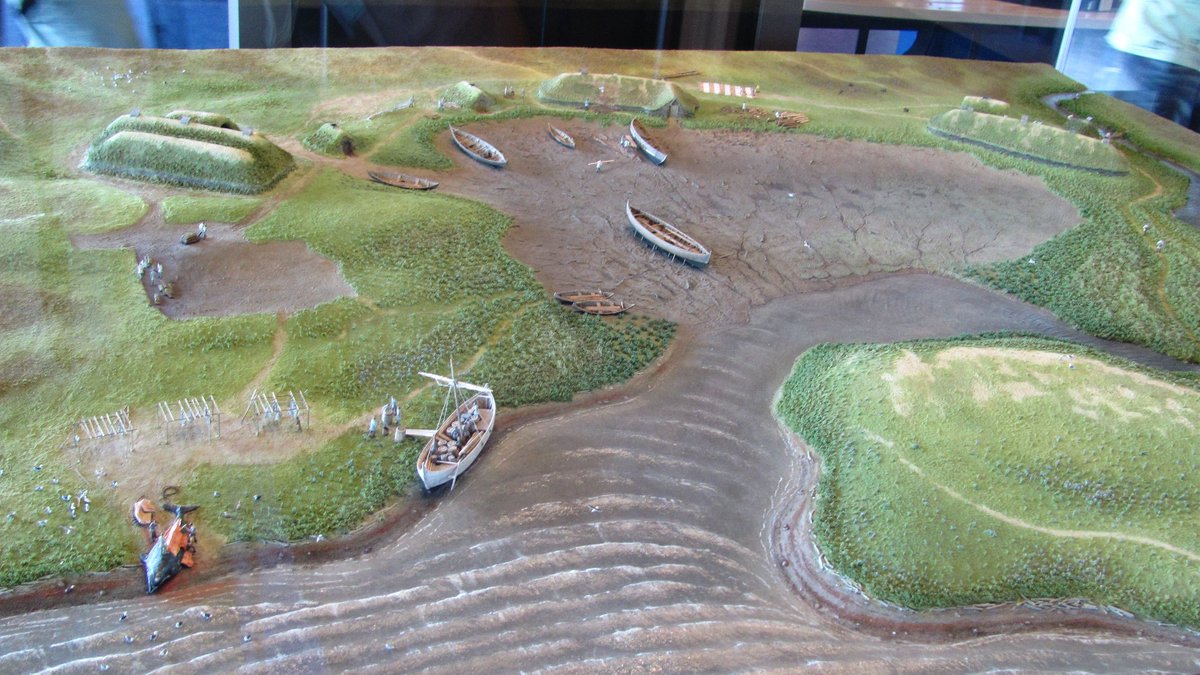
Scale model of the Viking settlement at L'Anse aux Meadows in Newfoundland Scale model of L'Anse aux Meadows Viking settlement by Torbenbrinker, via Wikimedia Commons (CC BY-SA 3.0) -
Landing in Labrador, which is mainland continental North America, gives Leif an arguably stronger claim to being the first European to set foot in North America than dad. It's not recorded what Bjarni Herjólfsson thought of his place in history as seeing it but not landing there.
-
The argument against Newfoundland is the name: "Vinland" means "Grapes", and tales of the voyages are heavy on mentions of bringing cargoes of wild grapes back to Greenland. But there are not tons of wild grapes in Newfoundland; there are some, but you find more further south.
-
The mostly likely solution is the "Vinland" was not a single town but the whole island, in the same way that "Greenland" and "Iceland" are. They probably had some settlements further south that we haven't discovered. Anyway, good going Leif, you were first European in America.
-
But a good question is: why didn't they stay? Faced with the overwhelming natural resources of North America, why the fuck would you go back to Greenland? There aren't even any trees there and you're all constantly starving to death. There's a bunch of good reasons.
-
First off: while Leif was away, there had been a pandemic that killed a bunch of Greenlanders including his dad, Erik the Red. This meant Leif was suddenly in charge of Greenland. This made him a rich and busy man, and he never got around to sailing to America again.
-
This left the further exploration and colonization of North America to other, less capable leaders. It also meant that Greenland, already a small population, had a lot fewer people to spare on adventuring. Meanwhile, the same plague that struck Greenland struck Europe.
-
The whole reason people had left Europe to Iceland and then Iceland to Greenland was lack of land and population pressure. The pandemic reversed that push; suddenly there was plenty of easy land to be had closer to Europe, with the economic benefits of a bigger population center.
-
The economy of Greenland also got fucked; "unicorn horns" (narwhal tusks) went out of fashion, and African ivory became cheaper and more plentiful, destroying the market for walrus tusks. On top of all that, there was a mini ice-age that made Greenland even colder and icier.
-
The Greenlanders attempting to make a go of things in North America also ran into a problem they hadn't in Iceland and Greenland: indigenous folk telling them to get lost. Viking sagas record native Americans who were initially friendly but eventually got tired of the Vikings.
-
The Vikings were not more noble or peaceful than later European colonizers of North America; they were just not as well armed. The indigenous people in fact kicked their asses, so they hightailed it back home.
-
The result of all this was that the Greenlanders pulled out of both North America and also of Greenland itself, returning to Iceland and Norway. Leif died in Greenland, and it was left to Columbus to really fuck up the Americas.
-
Our next thread is going to be William The Conqueror, later this week. I finally know what happened in 1066.
- Previously: Erik the Red
- Next: William the Conqueror
- Full list
Text and images copyright © 2020-2023 Laurie Voss
except where indicated
except where indicated